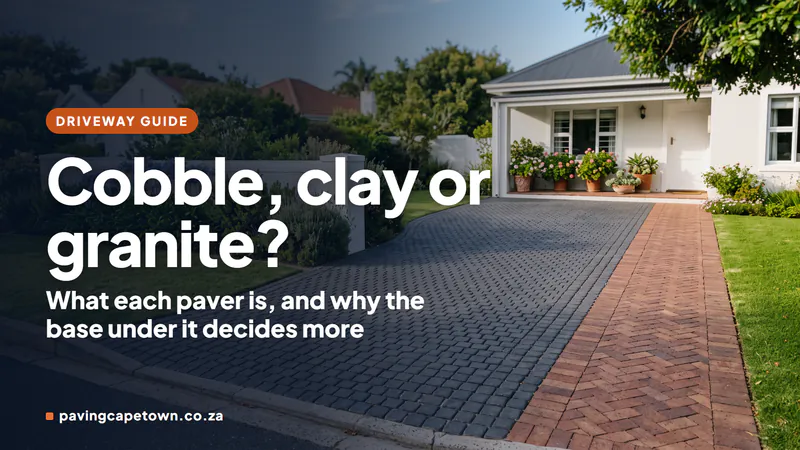
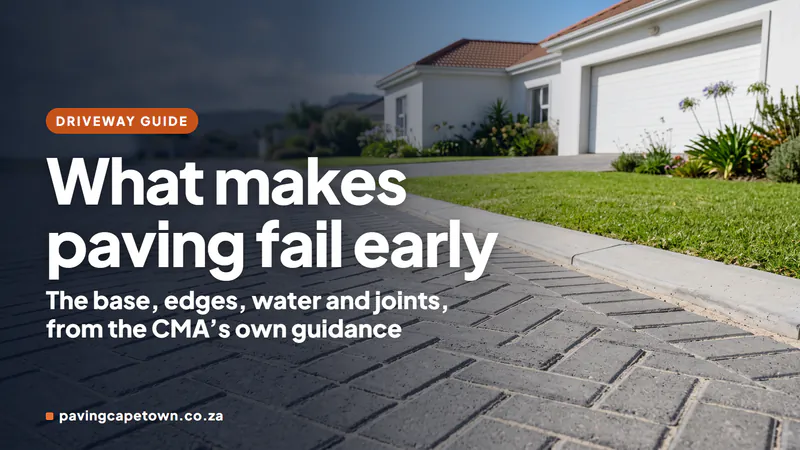
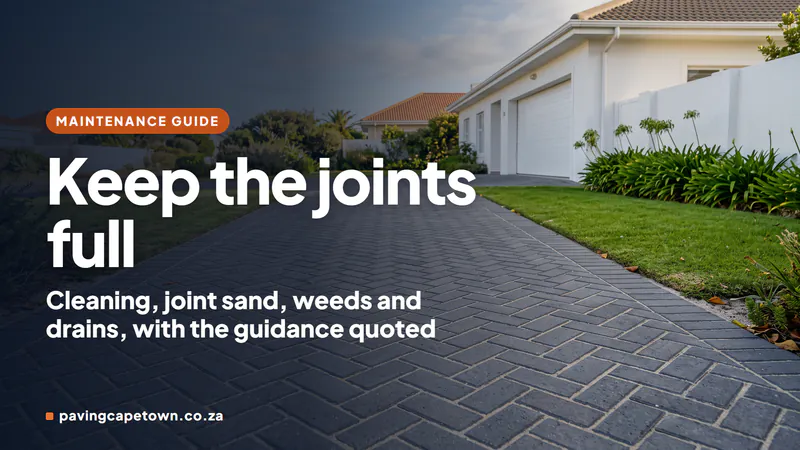
Three materials come up again and again on Cape Town pool decks: tumbled travertine, cleft slate and 20mm outdoor porcelain. They look different, weather differently and ask different things of you once they are down.
Where we stand: we quote all three for the pool surrounds we lay, so this is our experience, not lab data. There are no rand rates here, and no slip, heat or water-absorption figures: those belong to a specific product, not to a material.
The short version
- Tumbled travertine is the pale, textured one. It is the most porous of the three, so it needs a sealer re-applied periodically.
- Cleft slate is dark and riven and usually needs less sealing than travertine. Some slate sheds thin surface flakes, so the bedding has to be right.
- 20mm outdoor porcelain is uniform and modern, usually with no sealer. Repairs are specialist work.
- Slip resistance belongs to the range, not the material. Get its tested wet rating in writing.
- Whatever you pick, drainage matters: the CMA’s concrete block paving guidance puts most pavement failures down to water getting into the layers underneath [1].
What does a Cape Town pool deck have to handle?
Sun, splash, pool chemicals and bare feet, all summer. The base underneath matters whichever surface you choose.
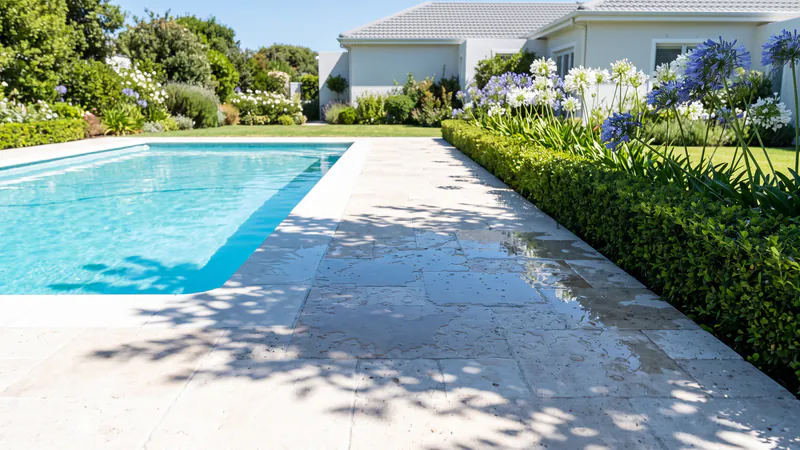
Of everything we build across Cape Town, a pool deck is the hardest-working surface. It takes:
- Overhead summer sun
- Wet-then-dry cycling from splash-out
- Chlorine and salt-chlorinator runoff, plus algae killer and pool cleaner tracked out on hands and feet
- Bare-foot traffic
Then there is the part nobody sees. The CMA’s design guidance for concrete block paving is blunt about where pavements fail: “Most failures of pavements are due to ingress of water into the pavement layerwork.” [1] On a deck splashed all summer, that is the sentence that matters.
Tumbled travertine: pale and textured
A pale, textured stone with a warm look that weathers gently, in exchange for periodic sealing.
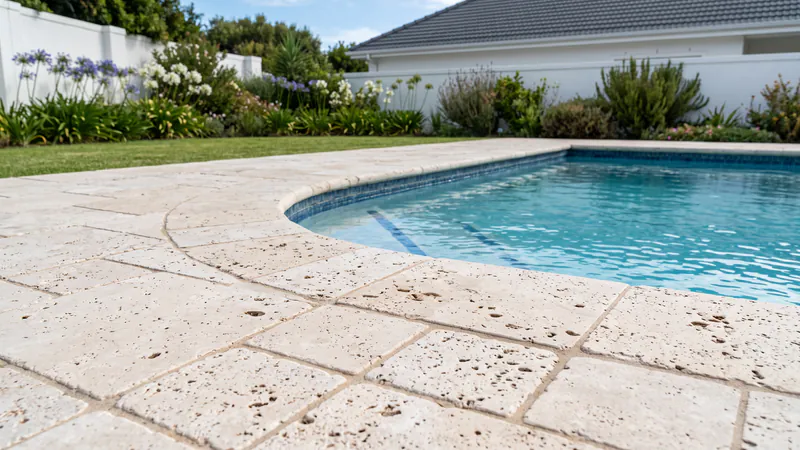
Travertine is a sedimentary limestone with an open, porous face: the small holes you can see run into the stone. It is quarried in several countries, Italy and Turkey among them.
Good
- A pale, warm colour range that suits Cape Dutch, modern coastal and traditional homes
- The texture is the stone’s own, straight off the tumbling drum, with no applied finish to wear off
- It weathers gently: chips and wear read as character rather than damage
Watch out for
- The pores are visible holes, and some clients dislike them. “Filled and honed” versions trade the natural texture for a smoother face
- The most porous of the three, so it takes up marks more readily than slate or porcelain
- An impregnating sealer reduces that and has to be re-applied periodically. Follow the guidance for the product you use, not an interval off a website
Cleft slate: the darker, textural alternative
Slate suits a dark, contemporary brief. It is denser than travertine and usually needs less sealing, but the bedding has to be right.
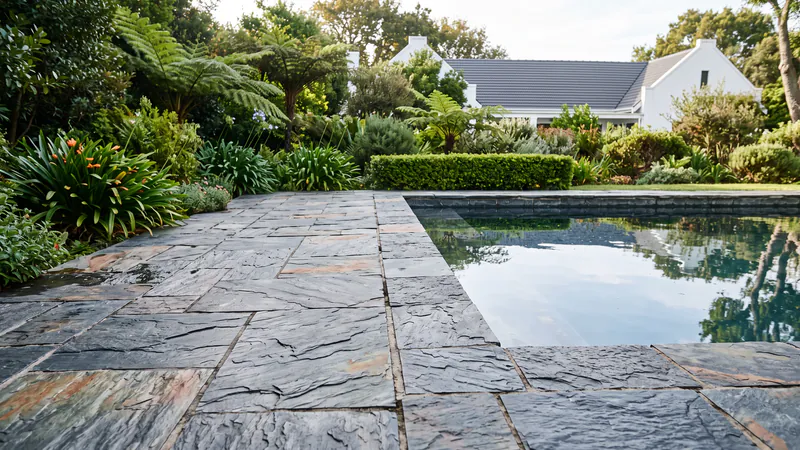
Slate splits along its natural cleavage planes, so a cleft-finish face is riven rather than sawn and no two pieces are identical.
Good
- The texture comes from the stone’s own cleft face, with no manufacturing step
- Dark, saturated colour for a contemporary look
- Denser and less porous than travertine, so it usually needs less sealing
Watch out for
- Slate is a layered stone and can shed thin flakes from its surface. Set properly into a mortar bed, riven slate is unlikely to delaminate
- The installation detail matters more here than with the other two, so check the finished work before you pay
- It still wants periodic sealing
20mm outdoor porcelain: the modern choice
The most consistent of the three, and usually the least upkeep. The trade-offs are a modern look and specialist repairs.
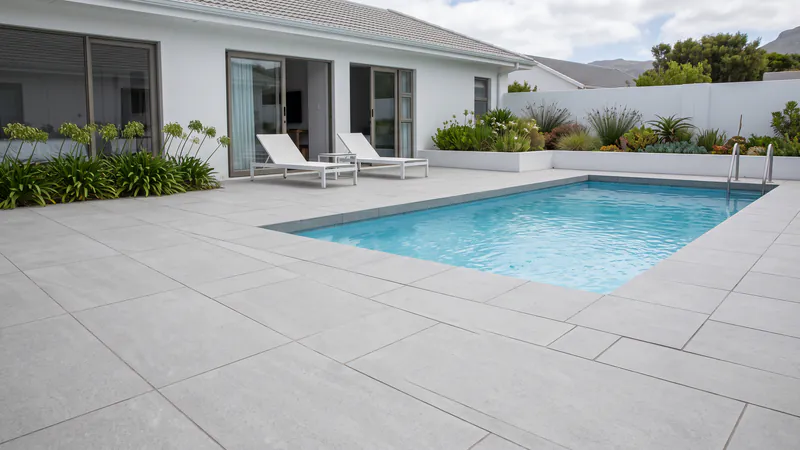
Porcelain pavers, the 20mm outdoor format and not indoor floor tile, are one of the three we quote for pool decks across Cape Town, Bishopscourt included. The body is clay blended with quartz and feldspar, fired until it is dense and far less porous than travertine.
Good
- The most dimensionally consistent of the three: tight, even joints with no grinding-to-fit
- Large-format options for a minimalist look
- Bullnose coping can be made off-site from the same porcelain and shaped to the pool, so the edge need not rely on on-site cutting
- Far less porous than travertine, and outdoor ranges are generally sold as needing no sealer. Confirm that on the range’s data sheet
Watch out for
- Lifting and re-setting a single piece is specialist work, not something you do on a Saturday
- The look is unapologetically modern, and it does not suit a heritage Constantia farmstead
- It comes in indoor and outdoor ranges, so choose one sold for outdoor use with a textured surface, and get its wet slip rating in writing
How do you know a pool deck won’t be slippery?
Ask the supplier for the tested wet slip rating of the exact range you are being quoted, in writing. A rating attached to a whole material is not a real figure.
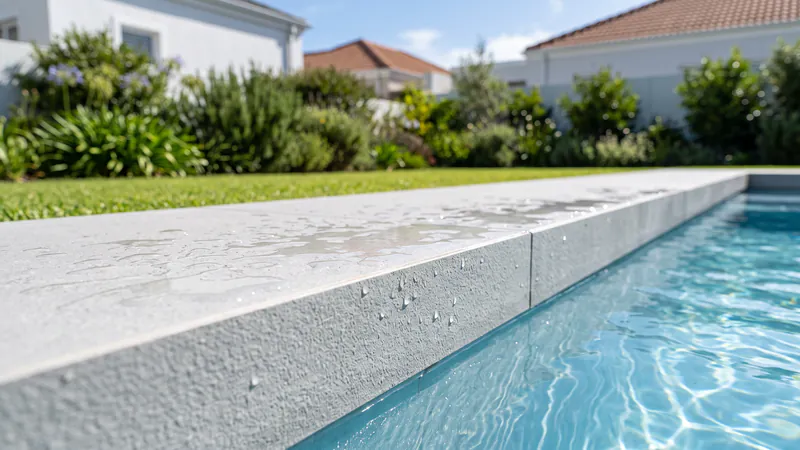
A wet slip rating comes from testing a specific product, and two travertines or two porcelains from different quarries and factories will not test the same. So treat any website that rates “slate” or “porcelain” as a category with suspicion, and compare the certificates for the ranges you are quoted instead.
So which suits your pool?
Our view, as a paving business: choose for the house and the upkeep you will actually do, then check the slip certificate.
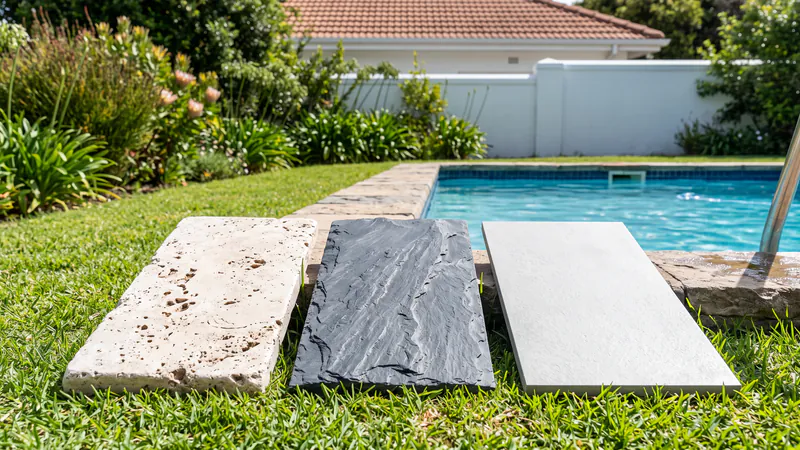
Tumbled travertine
Best for a pale, warm look
A pale, warm look that suits Cape Dutch, coastal and traditional houses. Budget for a sealer re-applied as the product’s guidance says.
Cleft slate
Best for a dark, contemporary brief
Usually needs less sealing than travertine. Only worth it if the bedding is done properly.
20mm porcelain
Best for the least upkeep
Usually no sealer to re-apply. Accept a modern look and a specialist for any repair.
If it is a driveway you are choosing pavers for rather than a pool deck, the shortlist is a different one entirely.
Which suits your part of Cape Town?
Mostly an aesthetic call. Near the sea, ask how the specific range has held up on the coast.
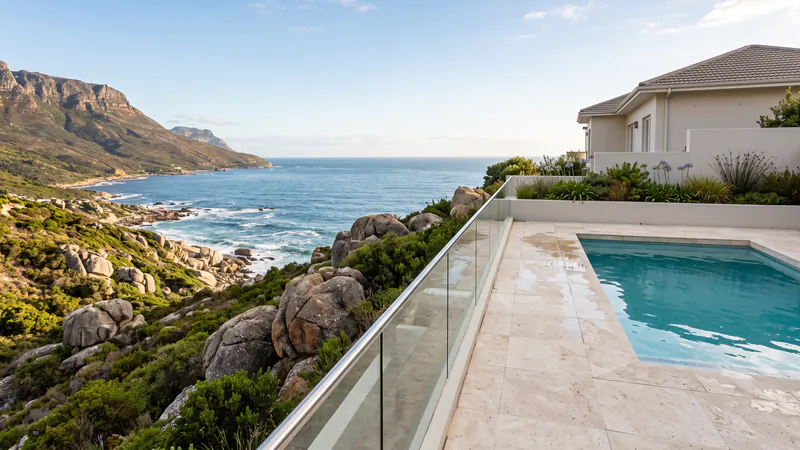
- Atlantic Seaboard (Camps Bay, Bantry Bay, Llandudno, Clifton): big glass and big views. Pale travertine and porcelain suit light palettes; dark slate is the contrast option.
- Southern Suburbs (Constantia, Bishopscourt, Tokai, Newlands): travertine suits heritage houses, slate sits well in shaded, planted gardens and porcelain suits contemporary new-builds.
- Helderberg and False Bay (Somerset West, Strand, Fish Hoek, Muizenberg): any of the three works on look; ask how the particular range has performed near the coast.
- Winelands (Stellenbosch, Paarl): bigger plots and farm-style architecture. Lighter travertine and large-format porcelain both suit.
Common Questions
What's the best paving for a pool surround?
There is no single best: tumbled travertine is the pale, textured option, slate the dark one and porcelain usually the least upkeep. Which is right for yours comes down to the architecture and how much maintenance you are willing to do.
Is travertine slippery when wet?
That depends on the finish and the specific range, not on "travertine" as a material. Tumbled travertine keeps the stone's own texture; polished and honed finishes don't, and we don't put those at a water's edge. Ask your supplier for the tested wet rating on the exact range they are quoting you.
Does slate work around a pool?
Yes, and it suits a dark, contemporary brief. It is denser than travertine and usually needs less sealing. Some slate sheds thin surface flakes, so the bedding has to be right.
How long does pool paving last in Cape Town?
We have not found a South African standard publishing service lives for these materials, so we are not going to put a number on it. What we can tell you is where pool decks go wrong, and it is rarely the stone: the CMA's design guidance puts most pavement failures down to water getting into the layerwork underneath [1]. Get the base, the falls and the drainage right and the surface is the easy part — see what actually decides how long paving lasts.
Can I use concrete pavers around a pool?
You can. It simply isn't what we specify when the brief is a stone or porcelain look. If budget is the driver, say so when we come out and we'll price the options against each other on your site.
Does porcelain need sealing?
Usually not. Outdoor porcelain is made dense enough that it is generally sold as needing no sealer, but not every range is made the same way, so check the data sheet for the one you are quoted. Travertine and slate both benefit from an impregnating sealer, re-applied as the sealer’s own guidance says.
Building or refurbishing a pool? We quote travertine, slate and porcelain side by side on the same site, so you can compare them on your own job. Here is how we work out a written price. Use the form on this page, or call 021 825 6396, weekdays 8am to 5pm.
Sources
- Concrete Manufacturers Association — Concrete Block Paving, Book 2: Design Aspects (§2.7 Drainage; sub-base and bedding design). cma.org.za (PDF)