Ask a Cape Town supplier for “paving bricks” and you may hear cobble, bevel, interlock, brick paver and clay brick, sometimes in the same quote. Few of those names tell you how the blocks hold together, and that is the part that matters on a driveway.
Where we stand: we arrange block-paved driveways across Cape Town, so this guide is written from the paving side. The rules quoted come from the Concrete Manufacturers Association (CMA) and the Clay Brick Association, which promote their own products, and from the Concrete Society of Southern Africa.
The short version
- Interlocking blocks key into their neighbours on every side. The CMA generally recommends this shape for heavy-duty paving [1].
- Rectangular blocks have no shaped interlock, so they rely on accurate blocks and careful laying [2].
- “Cobble” is a look, not a shape type. Ask which type a cobble is before it goes on a driveway.
- On a concrete block’s spec sheet, look for a chamfered edge and the right thickness: 50–60mm is generally adequate for a home, says the CMA [1].
- Clay brick and granite are different materials, not different shapes.
Shape comes first: the CMA’s three block types
The CMA sorts concrete paving blocks into three types by their outline: S-A, S-B and S-C. The type tells you how the blocks lock together; a product name does not.

In the CMA’s words, S-A blocks allow “geometrical interlock between all vertical or side faces of adjacent blocks”, S-B blocks between “some faces”, and S-C blocks “no geometrical interlock” [1]. Its drawing of an S-C block is a plain rectangle.
Book 3 adds that an S-C block “relies on its dimensional accuracy and the accuracy of laying to develop interlock” [2]. If your quote does not say which type the block is, ask.
Interlocking blocks: the CMA’s choice for heavy-duty paving
Zigzag-sided interlocking blocks fit the CMA’s type S-A. It says this type develops the best resistance to creep and generally recommends it for heavy-duty paving.
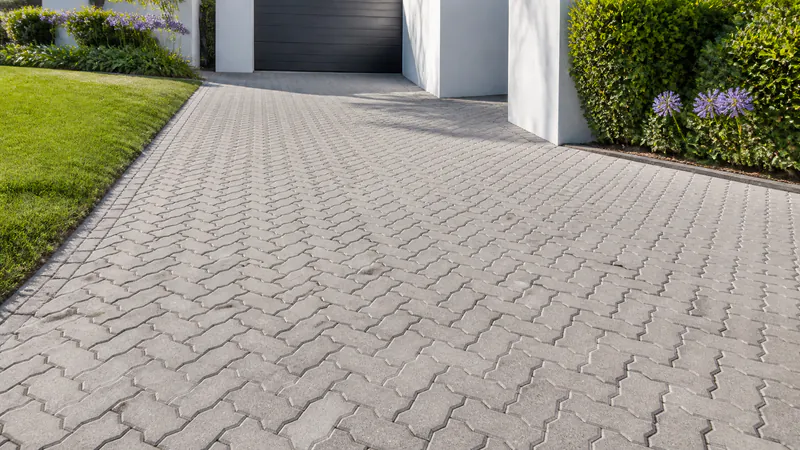
Good
- The best resistance to both vertical and horizontal creep, according to the research the CMA quotes [1]
- Generally recommended by the CMA for industrial and heavy-duty paving [1]; its paving guide adds that interlocking pavers give better performance under heavy traffic [3]
- Can generally be laid in herringbone, the CMA’s strongest basic pattern [1][2]
Watch out for
- In our view, the zigzag outline looks busier than a plain rectangle, which does not suit every house
- Shaped sides do not lock on their own: the CMA says interlock comes when the joints are completely filled with jointing sand [1]
Creep here means blocks slowly shifting under traffic. Shaped sides resist it, but the edges matter too: the CMA says all concrete block paving must have an edge restraint [1], and we explain how weak edges let paving creep apart.
Rectangular blocks: the plain shape
The plain rectangle is the CMA’s example of type S-C. With no shaped sides, it depends on accurate blocks and careful laying.
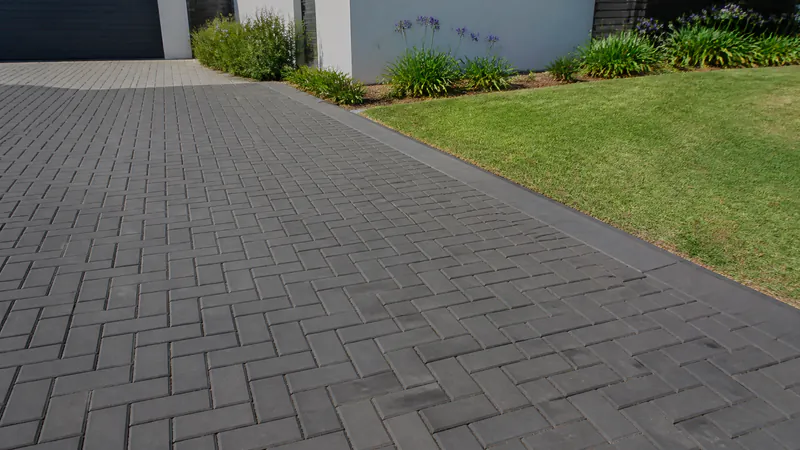
Good
- The CMA shows three basic patterns: stretcher, herringbone and basket weave [1]. In our view, a rectangle is the easiest shape to lay in any of them
- In our view, clean straight lines suit contemporary houses
Watch out for
- No shaped interlock, so it relies on the accuracy of the blocks and the laying [2]
- Size matters: the CMA wants blocks within ±2mm on plan and ±3mm in height for a smooth surface and good interlock [1]
The CMA says herringbone gives the best resistance to horizontal and vertical deformation of its three basic patterns [1]. For how each pattern looks on a real frontage, see herringbone, stretcher and basket weave in practice.
Cobbles: a look, not a shape type
“Cobble” describes small blocks with an old-stone look. It is not one of the CMA’s three types, so the name alone tells you nothing about how a block interlocks.
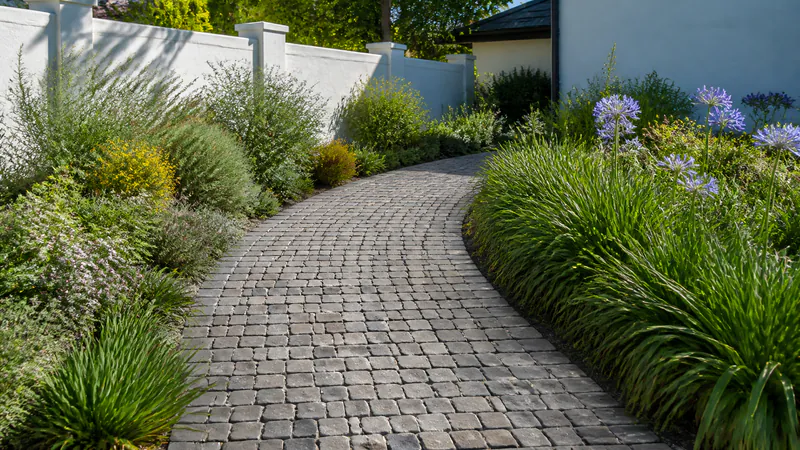
Good
- In our view, small units follow a curve neatly, which is why they suit cobbled garden paths
- If the cobble has a rough face, it grips better: the CMA says rougher blocks provide better skid resistance, smoother ones look better [2]
Watch out for
- The name does not tell you the shape type, thickness or standard, so ask for all three
- Before cobbles go on a driveway, check they are thick enough for cars: the CMA’s domestic figure is 50–60mm [1]
Charcoal cobble against clay brick and granite is a question of material, which our material-by-material comparison covers.
Bevels, thickness and spacers: what the spec sheet should say
Look for a chamfered top edge, a thickness that suits the traffic, and compliance with SANS 1058, the product standard for concrete paving blocks.
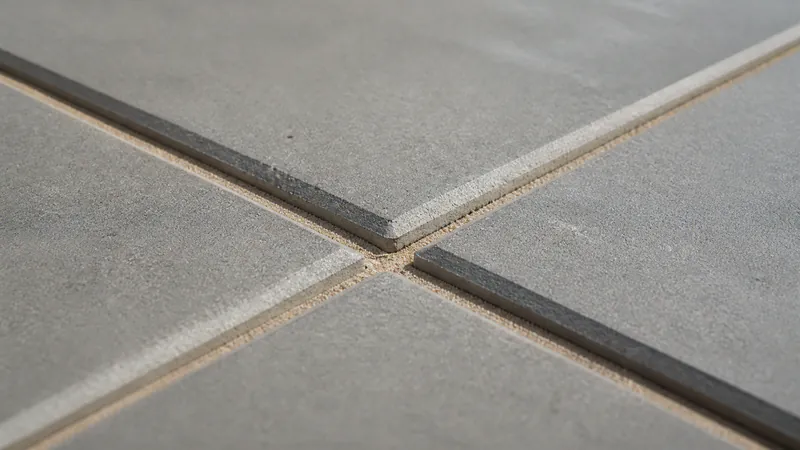
- Chamfer (bevel): “Most concrete paving blocks are chamfered”, which the CMA says improves their performance and appearance [1]. Its step-by-step guide adds that chamfers help water drain and reduce chipping [3].
- Thickness: “Generally for domestic use, 50 – 60 mm blocks are adequate. For industrial use an 80mm paver is recommended” [1].
- Spacers: small lugs on the sides give uniform gaps for the jointing sand [3].
- Standard: concrete paving blocks are specified under SANS 1058 [4]. Ask the supplier to confirm the block you are buying meets it.
A product called a “bevel” or “interlock” paver should still come with these details. If they are missing, ask before you order.
Clay brick, granite and permeable paving
These differ by material or by drainage, not by outline. Clay pavers have their own SANS standard and classes; granite setts are natural stone.
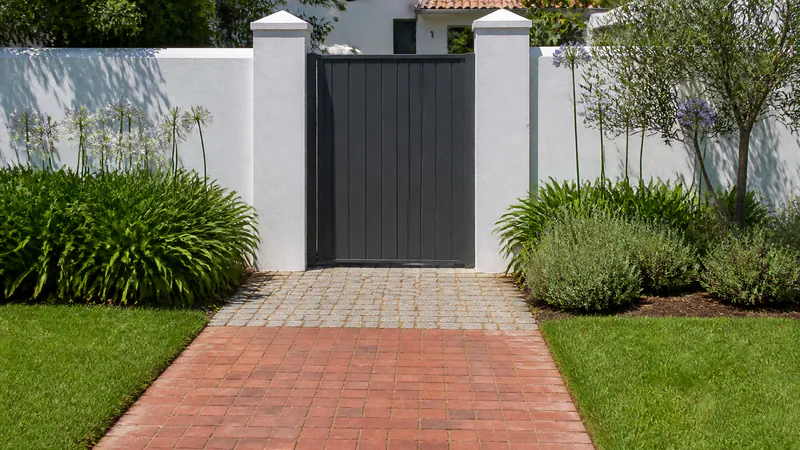
- Clay pavers are fired clay made to SANS 1575. Class PA units “may have chamfered arrises”; Class PB units have edges “that are not chamfered” [5].
- Clay patterns: the Clay Brick Association recommends 45° or 90° herringbone where wheels go; other decorative patterns “are only suitable for pedestrian areas” [5].
- Granite setts are natural stone, outside both the concrete and the clay guidance, so judge them on the supplier’s data and a sample.
- Permeable block paving is a different build-up altogether: paving that lets rain through its joints.
So which type suits your job?
Our view, as a paving business: match the shape to the traffic and the look to the house, then put the care into the base and the edges.
Interlocking (S-A)
Best for heavy traffic
The CMA generally recommends it for heavy-duty paving. Lay it in herringbone.
Rectangular blocks
Best if the pattern matters
In our view, herringbone on the drive and stretcher or basket weave on a patio. Check the joints at handover.
Cobbles
Best for paths and courtyards
Ask which shape type and thickness they are before they go under a car.
Whatever the block, a sign-off check on the finished joints and levels is worth doing before you pay. If the driveway is part of a bigger job, see the other paving jobs we cover.
Common Questions
What are the different types of pavers?
By material, the main ones are concrete blocks, clay pavers and natural stone such as granite. Concrete blocks are also sorted by shape into the CMA’s three types: S-A interlocks on all sides, S-B on some, and S-C, such as a plain rectangle, not at all [1].
Which paver block design is best?
For heavy-duty paving, the CMA says type S-A blocks develop the best resistance to creep and generally recommends them [1]. For a home, where it calls 50–60mm blocks generally adequate [1], the choice often comes down to looks, provided the blocks are laid well.
Which paving pattern is the strongest?
Herringbone. The CMA says it ensures the best resistance to both horizontal and vertical deformation [1], and the Clay Brick Association recommends 45° or 90° herringbone for areas with wheeled traffic [5].
What are the disadvantages of interlocking pavers?
In our view, mainly the look: the zigzag outline is busier than a plain rectangle. Like any block paving, they still need an edge restraint and completely filled joints to lock together [1].
What are the disadvantages of cobblestone?
With concrete cobbles, the name hides the detail: it does not tell you the shape type, thickness or standard, so ask for all three. A rough face grips better but, per the CMA, smoother blocks look better [2], so pick the texture for where it will go.
Not sure which block suits your driveway or path? We do free on-site assessments across Cape Town and follow up with a written quote, with no obligation to use us for the work. See how a paving job is priced, or call 021 825 6396, weekdays 8am to 5pm.
Sources
- Concrete Manufacturers Association — Concrete Block Paving, Book 2: Design Aspects (4th ed., 2004): §2.3 bedding sand layer; §2.4 concrete paving blocks (block shape, Figures 3a–3c, thickness, dimensional tolerance, chamfer, laying patterns); §2.6 edge restraints. cma.org.za (PDF)
- Concrete Manufacturers Association — Concrete Block Paving, Book 3: Specification and Installation (5th ed., 2009): §3.1 units, with commentary on block type and texture. cma.org.za (PDF)
- Concrete Manufacturers Association — A step-by-step guide to perfect paving (2016), Step 1.1 choosing the right pavers. specifile.co.za (PDF)
- Concrete Society of Southern Africa — The manufacture of concrete paving blocks (2024), §2.2 specification requirements. concretesocietysa.org.za (PDF)
- Clay Brick Association — Clay Paving Guide: A Technical Handbook (2016): Part Three, specifying clay pavers (SANS 1575 classes); §4.2.5 laying patterns. claybrick.org (PDF)