Most people start a paving project by choosing a paver. It is the enjoyable part, but in our view the layout does more to decide how the front of your house ends up looking. Two driveways in the same charcoal cobble can look completely different, depending on how the field is set out, where the borders run and whether the pattern lines relate to the house.
Where we stand: this is how we lay out the driveways we pave across Cape Town and the front gardens around them. The rules quoted come from the Concrete Manufacturers Association (CMA), the precast concrete industry’s body, which says laying patterns “are determined by performance and aesthetic requirements” [1]. The look is half the brief.
The short version
- Layout first: run the pattern lines square to the house or the main kerb, as the CMA spec asks except in curved patterns [2].
- Herringbone where cars drive: the CMA says it resists deformation best [1] and recommends it for roadways and industrial applications [2]. In our view stretcher and basket weave are chosen mostly for looks.
- A border course frames the field and gives the cut edge a straight line to finish against, but it is not the edge restraint that holds the paving in.
- Break up a big driveway with a darker band, wheel strips with grass, or an entrance apron.
- Water decides the rest: a fall of at least 2% is generally required [1].
Start with the shape of the space, not the paver
Line the pattern up with the house, the garage door or the main kerb. Paving laid off-square tends to show along the joint lines.
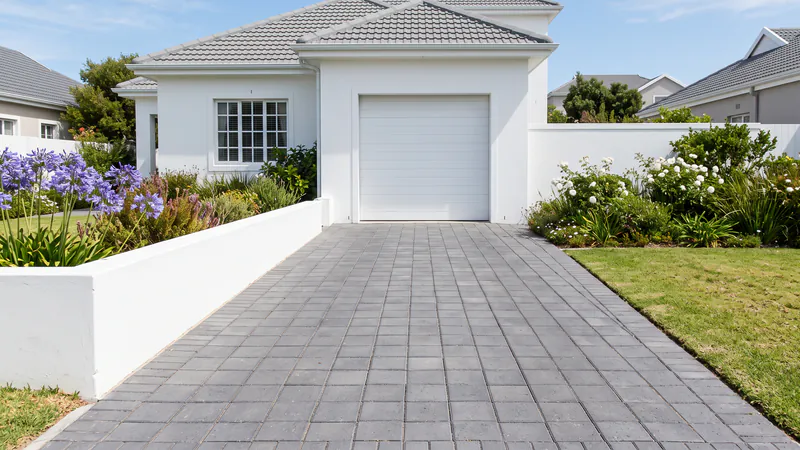
The CMA’s installation guidance puts a rule on it. Except where curved patterns are required, “the lines of the unit pattern shall be visually straight and parallel to major kerbs or buildings or other structures, as most appropriate” [2].
- Why it shows: paving a few degrees off the line of the house tends to catch the eye along the joint lines.
- Narrow frontages: on a tight, narrow drive, in our view a bond square to the wall does more for the look than a better material.
- Where the cuts land: set out square to the house and the ragged edge goes to the boundary, where a border can absorb it. Set out to the boundary and it lands at your front door.

The three basic bonds, and what each one does
Stretcher, herringbone and basket weave. Herringbone is the bond the CMA singles out for resisting deformation; in our view the other two are chosen mostly for the look.
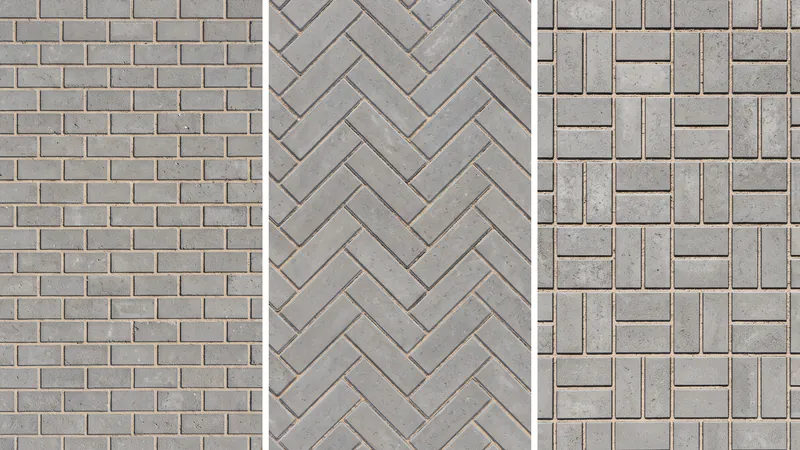
The CMA illustrates these three and adds that “numerous other patterns are also possible” [1].
Stretcher
Calm, modern, long spaces
Offset rows like brickwork. The lines pull your eye down a narrow space, and the cutting is predictable.
Herringbone
Anywhere cars turn
Blocks interlocked at 45° or 90°. The CMA says it “ensures the best resistance to both horizontal and vertical deformation” and generally recommends it for industrial pavements [1].
Basket weave
A traditional look
Pairs of blocks at right angles, in squares. To our eye it suits older Cape Town houses better than a crisp stretcher field.
Where no other pattern is specified, the CMA’s installation spec makes herringbone the default if the block shape permits [2]. In our view, on any surface a car turns on, that outranks taste, and checking the bond is part of the walk-round we recommend before you pay.
The CMA does not recommend “cut units smaller than about 25% of full unit size”, as “these small units can be dislodged under traffic” [2]. Curves, diagonals and 45° herringbone usually create more small cuts than a square stretcher field, one reason a curved driveway is quoted differently from a rectangle of the same area.
Borders make paving look designed
One contrasting course around the edge frames the field and gives the cut edge a straight line to finish against. Don’t mistake it for the edge restraint.
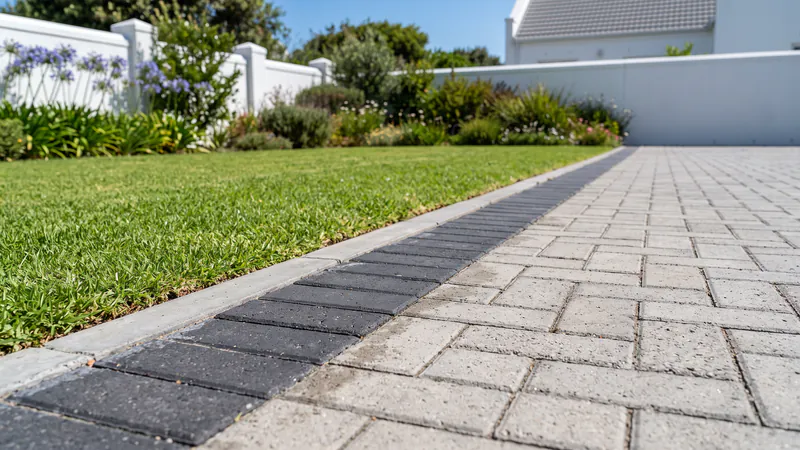
What a border does
- Frames the field: the CMA’s construction details call it a header course [2]
- Gives a clean line where paving meets grass or a wall, and a straight line for the cut edge to finish against
- Pairs with turning herringbone along the edge restraint, which the CMA says “will eliminate the need to cut blocks longitudinally” [2]
What it is not
- An edge restraint. “All cbp must have an edge restraint”, which “may be cast in situ or precast or could be the existing structures” [1]
- The restraint holds the paving in; the border is what you see. One element can do both, but never assume a tidy edge is structural
Without a restraint the field creeps and the joints open, which is how a driveway ends up needing lifting and relaying.
Three ways to break up a big driveway
A darker band, wheel strips with grass down the middle, or an entrance apron. None needs a more expensive paver.

- A two-tone field. Coloured blocks “will add another dimension to the visual effect created by concrete block paving”, says the CMA [1]: a darker band along the drive, or a second colour where the cars stand.
- Grass strips. Two paved wheel tracks with a planted strip between. In our view one of the best ways to stop a drive reading as a slab, and suited to a straight run up to a garage.
- An entrance apron. A distinct area at the gate in a different bond or material, so arriving feels like arriving somewhere.

Grass strips do cut the hard surface, so some rain soaks in. But if water running off into the road is the real problem, a strip of lawn only takes a slice out of it; a properly permeable build-up is what deals with runoff.
The front garden: paths, planted joints and the verge
The front path is what every visitor walks on. Stepping stones with planted joints soften it, if you can live with the weeding.

Garden pathways are as much a part of what Paving Cape Town takes on as driveways.
Good
- Planted rather than sanded joints give a soft edge
- The path reads as part of the garden, not a channel through it
- In our view it suits fynbos or indigenous planting better than a hard-edged rectangle
Watch out for
- Planted joints need weeding
- Awkward for a wheelbarrow or a wheelie bin
- Stones too small for one stride turn a path into decorative islands
We lay stepping stone and flagstone paths as well as drives, so a frontage can be planned as one. The strip between boundary wall and road is the part most easily forgotten; carrying the border course across it ties the frontage together, but check what your local rules allow first.
Falls and levels will overrule your drawing
Paving needs a fall so water runs off. A layout that sends water towards the house is worse than a plain one that drains away.
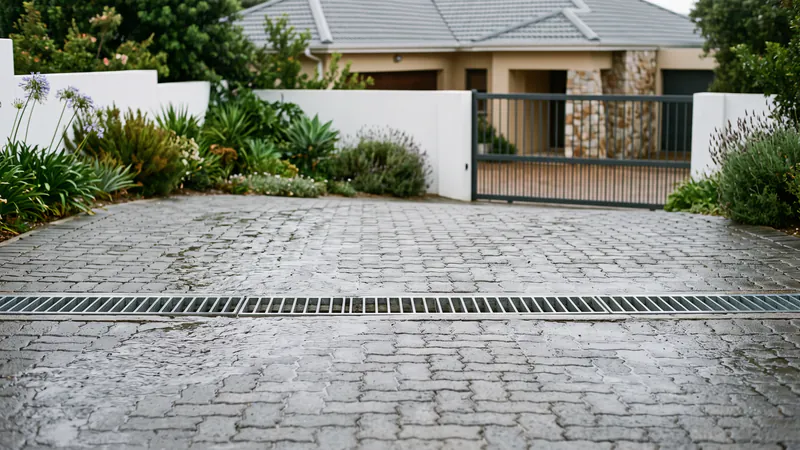
- Minimum fall: “a minimum fall of 2% in any direction is generally required” [1]. A perfectly flat courtyard is not on the menu.
- At drains and channels: paving is laid proud of stormwater structures, 5 to 10mm higher [1].
- Why: “most failures of pavements are due to ingress of water into the pavement layerwork” [1]. Where the water goes is decided at layout stage.
So which layout suits your frontage?
Our view, as a paving business: decide what the drive has to do, square it to the house, then choose the bond and border.
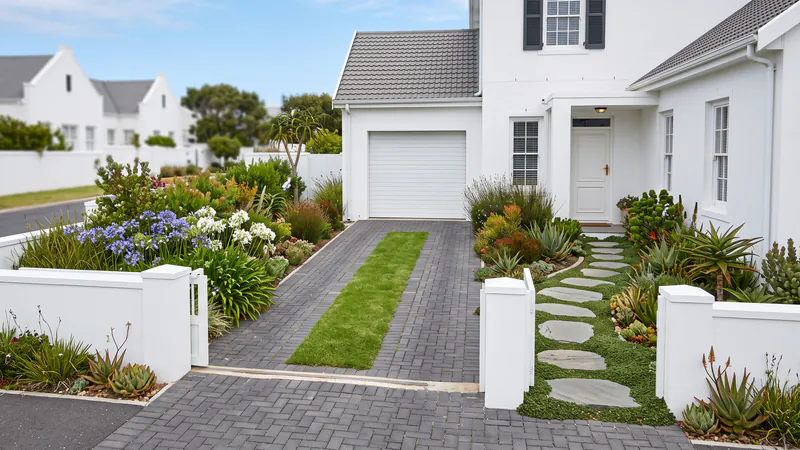
Herringbone with a border
Best where cars turn or park
The bond the CMA rates best against deformation, framed by a contrasting course.
Wheel strips and grass
Best for a straight run to a garage
Less hard surface and a long drive broken up. Helps with runoff, but no substitute for a permeable build-up.
Stepping stones
Best for the path to the door
Soft, and in our view right for an indigenous garden. Expect weeding.
The paver comes after the layout; for that, we put charcoal cobble, clay brick and granite side by side.
Common Questions
What are some popular driveway paving designs?
The layouts in this guide are herringbone with a contrasting border, wheel strips with grass down the middle, a two-tone field with a darker band, and an entrance apron in a different bond. All are variations on the CMA’s three basic patterns: stretcher, herringbone and basket weave [1].
Which paver pattern is best?
For anything vehicles drive or turn on, herringbone: the CMA records the best resistance to horizontal and vertical deformation [1], and makes it the default where the block shape permits and no other pattern is specified [2]. On a path, patio or courtyard where the only load is people, the choice is about looks.
What is the cheapest option for paving a driveway?
In layout terms: the smallest area that works, one material, a simple rectangle, and a stretcher or 90° herringbone bond with no curves. Curves, diagonals and changes of material generally add cutting, and cuts under about 25% of a full unit are not recommended anyway [2]. We don’t publish a rate per square metre, but what a paving quote is actually made of shows which lines your design moves.
What are the latest trends in garden paving?
We have no trend figure we can source, so we won’t give one. If you want a frontage that reads less like hard surface, look at planted joints, stepping stones through groundcover, grass strips through a driveway, and mixing two materials.
What to do instead of paving?
Or pave less: wheel strips instead of a full-width drive, stepping stones instead of a continuous path. If water running into the street is the worry, permeable paving addresses it directly. If tar or a concrete slab is on your shortlist, here is how the three surfaces compare.
What do you put down before block paving?
A compacted subgrade, a sub-base built to the site’s requirements, then bedding sand: 25mm after compaction, with a 10mm tolerance either way [1]. The CMA says bedding sand should not be used as a levelling course to fill hollows in the sub-base surface, as that leads to settlement [1]. None of it shows in the finished job, so get it written into the quote.
Want a layout worked out for your own frontage? We measure up at your place for free and put a written price in front of you, with no call-out fee. Fill in the form on this page, or call 021 825 6396, weekdays 8am to 5pm.
Sources
- Concrete Manufacturers Association — Concrete Block Paving, Book 2: Design Aspects, fourth edition, 2004 (bedding sand, sec 2.3; laying patterns and coloured blocks, sec 2.4; edge restraints, sec 2.6; falls and water ingress, sec 2.7). cma.org.za (PDF)
- Concrete Manufacturers Association — Concrete Block Paving, Book 3: Specification and Installation, fifth edition, 2009 (pattern alignment and herringbone default, sec 5.4; minimum size of cut units and reorientating herringbone at edges; header course detail). cma.org.za (PDF)