A back-garden patio is paving you live on rather than drive over: breakfast in the sun, the braai on a Saturday, the table where people end up sitting too long. Get where it goes and how big it is right, and the choice of paver becomes the easy part.
Where we stand: these are the ideas we talk through when we plan a patio for a Cape Town back garden. The rules quoted come from two industry bodies that promote their own products, the Concrete Manufacturers Association (CMA) for concrete paving and the Clay Brick Association for clay pavers.
The short version
- Place it first: off the room you live in, where the sun and the wind suit how you will use it.
- Size it for the furniture: set out your real table and chairs on the lawn and mark around them.
- Patterns are open: a patio carries feet, not cars, so the decorative bonds the Clay Brick Association limits to pedestrian areas are all available [3].
- Leave room to grow: the CMA says to leave enough unpaved space around a tree trunk for water to reach the roots [2].
- At the back door, the paving falls away from the house [1][2] and, in our view, stays well below the damp-proof course.
Put the patio where you will actually sit
Start at the door you use most, usually the kitchen or living room, then check the sun and the wind before you fix the spot.
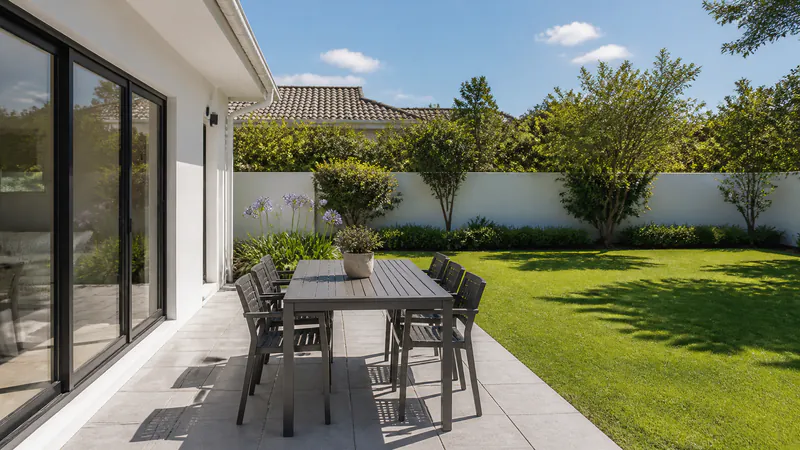
- Off the house, not across the lawn. Straight outside the door, a patio becomes an extra room; in our view, one you have to walk to gets used less.
- Sun. In Cape Town the midday sun sits in the northern sky, so a patio on the north side of the house gets the most of it, and one on the south side can sit in the house’s shadow for much of winter.
- Wind. If your garden takes the summer south-easter, a wall, hedge or screen on that side will do more for the patio than any paver.
Size it around the furniture, not the lawn
Put the actual table and chairs on the grass, pull the chairs out as if people are sitting, and peg a line around that with room to walk past.
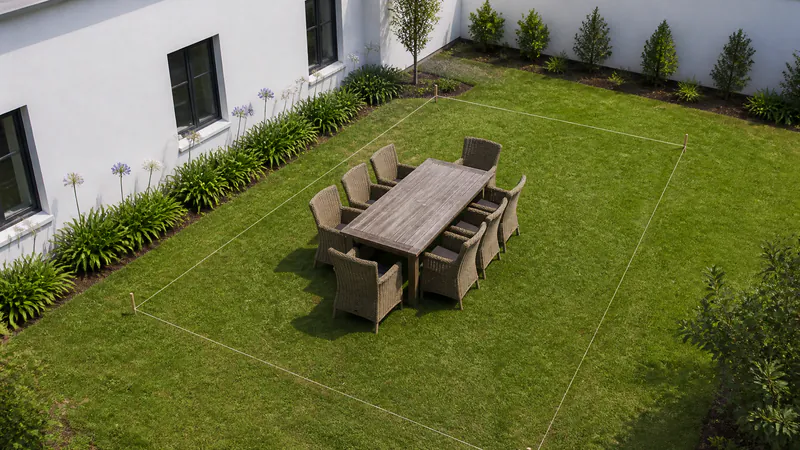
A plan has no chairs pushed back from a table, so in our view a patio drawn on paper tends to come out too small. Pegging it out fits the CMA’s laying sequence, which begins with setting out: “mark out where paving will go” [2].
Good
- You see the real size before anything is dug up
- A garden hose laid on the grass shows a curved edge the same way; the CMA suggests one to outline curves [2]
Watch out for
- Curves and odd angles mean more cut pavers, and more cutting shows up in the quote
- A bigger patio is more hard surface for rain to run off, so the falls matter more
Patterns: a patio is foot traffic, so you can play
Where wheels run, the Clay Brick Association recommends herringbone. A patio only carries people, so basket weave, stretcher and decorative bonds are all open to you.
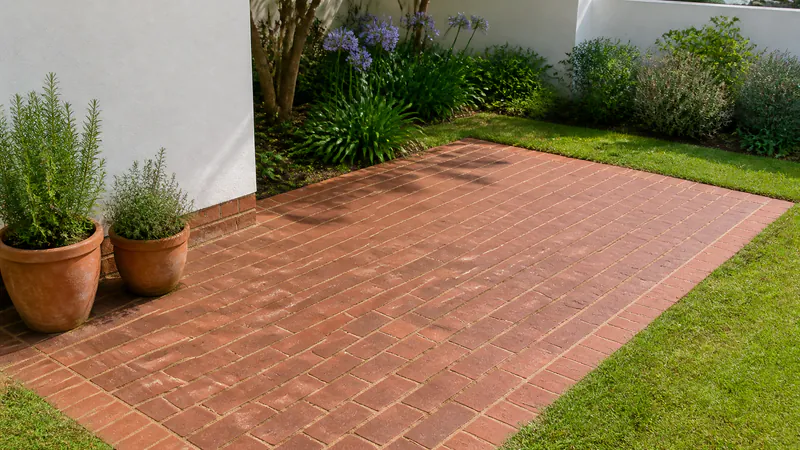
The Clay Brick Association’s paving guide shows twelve laying patterns and says herringbone (45 and 90 degree) “is recommended for wheeled traffic areas. Many other decorative laying patterns are possible but are only suitable for pedestrian areas” [3]. The CMA puts it more generally: “Patterns are determined by performance and aesthetic requirements” [1].
- Basket weave looks traditional, and suits clay brick and older houses.
- Stretcher bond laid lengthways makes a narrow patio feel longer.
- Large flagstones in natural stone or concrete give fewer joints and a calmer surface.
- A border course in a contrasting colour frames the whole area. The layout ideas in our driveway and front garden guide apply here too, minus the cars.
For the material itself, charcoal cobble, clay brick and granite compared covers the three most common block options.
The braai area: a floor you can scrub
Pave right up to the braai and give it a floor that takes a spill and a scrubbing brush, with the fall carrying water away from both braai and house.
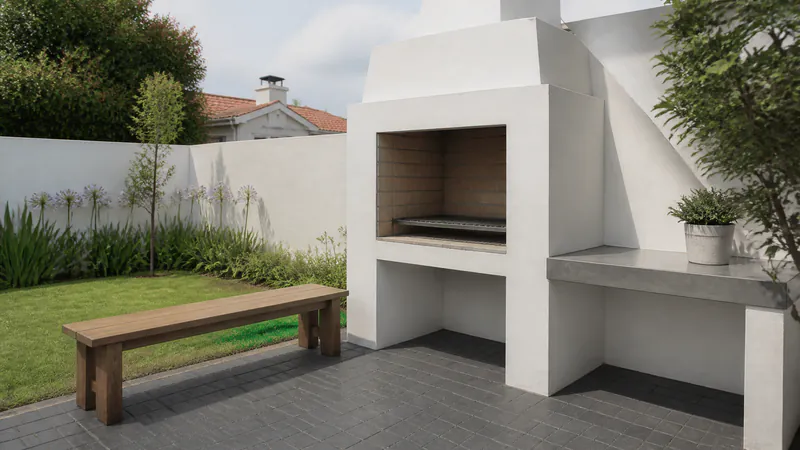
What works
- Paving that runs to the base of the braai, so there is no lawn to wear bald where the cook stands
- A worktop beside the braai, so plates and marinades go on it rather than the paving
- The braai at the side of the patio, where the smoke does not sit over the table in your usual wind
Watch out for
- In our view, pale porous stone is a risky choice right under the grill. Ask the supplier how the range handles grease
- A braai set on the lowest point of the patio sits in the puddle after rain
For clay pavers, the Clay Brick Association’s advice on food stains is short: “Scrub with a full-strength commercial detergent and rinse well” [3]. For stone and porcelain, follow the product’s own care guide; our paving maintenance guide covers the rest of the cleaning.
Soften it: planting, trees and the edges
Cut a bed into the paving, leave trees an unpaved ring, and give the edge where paving meets lawn a proper restraint.
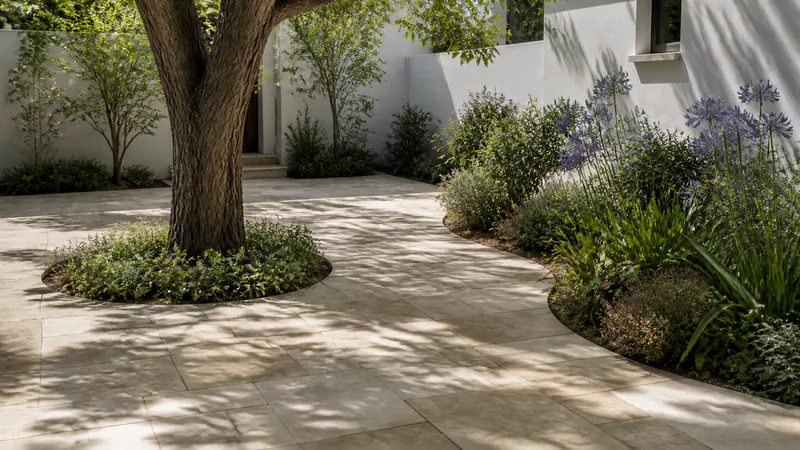
- Trees. The CMA’s laying guide warns that “paving around trees with shallow root systems will give problems, and requires regular maintenance”, and says to “allow enough un-paved space around tree trunks to allow water to reach roots” [2]. A planted ring turns that into a feature.
- Shade. Moss and mould are “common, particularly in shady or damp parts of the pavement”, says the Clay Brick Association; they “will not damage the pavement but may cause it to become slippery” [3]. Plan the shaded corner as a place to sit, not the main walkway.
- The edges. The CMA guide says “Kerbs are always required, even in NO TRAFFIC situation”, and shows a hidden restraint with the first paver concreted into place [2]. That applies wherever the paving stops: at the lawn, and around the rim of every bed and tree ring.
A stepping-stone or flagstone path from the patio to the far end of the garden ties it all together, and garden paths are something we can plan with the patio.
At the back door: falls, levels and the damp-proof course
The paving falls away from the house and, in our view, stays well below the damp-proof course in the wall.
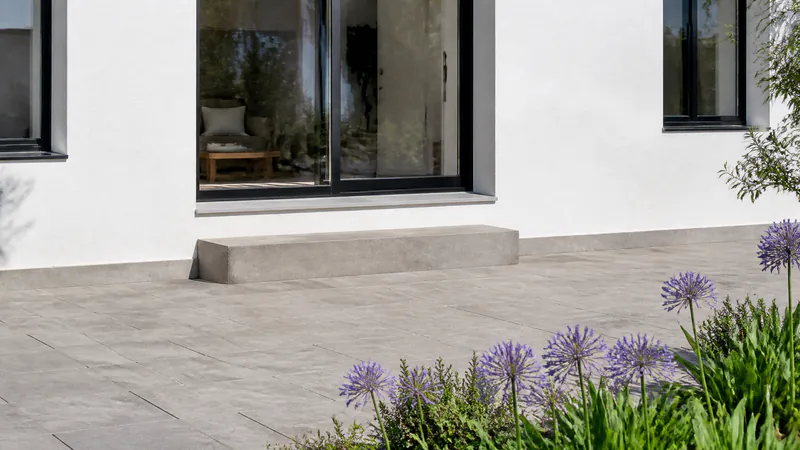
- Fall away from the house. For block paving, the CMA guide says to “Slope paving away from wall”, and its site-inspection drawing gives a minimum slope of 1 in 50 in one direction and 1 in 100 in the other [2]. Its design guide is stricter: “a minimum fall of 2% in any direction is generally required” [1].
- Why it matters: “Most failures of pavements are due to ingress of water into the pavement layerwork” [1]. Against a house wall, standing water is also the wall’s problem.
- The damp-proof course. In our view, keep the finished patio well below the damp-proof course, the waterproof layer built into the bottom of the wall, and check it before the level is set: a patio laid higher than the old ground can bridge it.
- The wall as the edge. Where the house wall holds the paving in, the wall does the kerb’s job, so no separate kerb is needed there [2].
Once it is laid, the flood test in our sign-off checklist shows whether water really runs away from the house.
Covered patios and roof water
A roof or pergola over the patio concentrates rain at the gutter line and the downpipe. Decide where that water goes before the paving goes down.
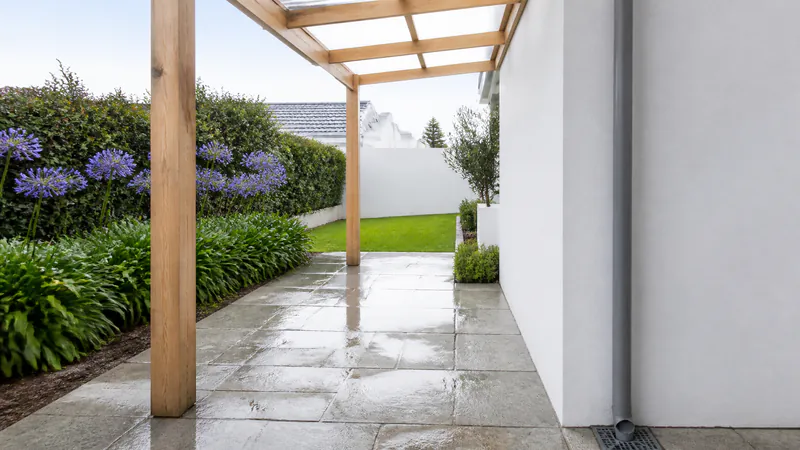
The CMA singles out “the outlet of a downpipe from a roof” as an area “subjected to concentrations of water” that needs its joints treated differently [1]. In our view the simpler fix is not to discharge a downpipe onto the paving at all, but into a stormwater drain or channel, never a sewer gully. The patio’s fall still runs away from the house, so any surface channel belongs at the low, outer edge.
So which patio idea suits your garden?
Our view, as a paving business: fix the place and the size first, then the pattern and the material.
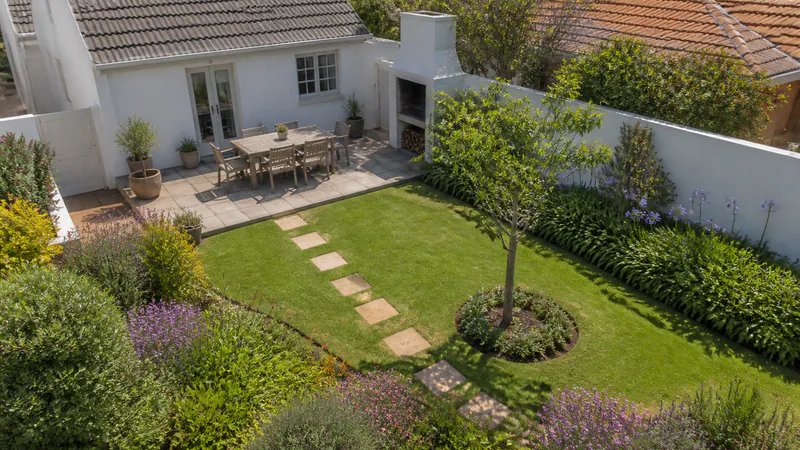
The everyday patio
Best off the kitchen or living room
Sized around your table, falling away from the house. The one you will use most.
The braai patio
Best if you entertain
Paved to the braai, with a worktop and a surface you are happy to scrub.
The garden patio
Best for a big or planted garden
Smaller, with planting cut in and trees left room, linked to the house by a path.
Paving right up to the water is a different job with its own materials; for that, our travertine, slate and porcelain pool deck comparison is the place to start.
Common Questions
What is the cheapest way to pave my garden?
Pave less and keep it simple: the smallest area that fits your furniture, one material, a square shape and a plain bond, since curves and changes of material add cutting. We don’t publish a rate per square metre, but what a paving quote is made of shows which lines your design moves.
Can you lay paving slabs straight onto soil?
Not onto loose soil. Block pavers go on a screeded bedding sand layer over a compacted base, inside edge restraints [2]; for clay pavers on a single house, the Clay Brick Association says that base is often the levelled and compacted soil itself [3]. The CMA warns that if the base is uneven or poorly compacted, “Paving will take up same contours!” [2] Stone and porcelain slabs are a different job: they are set in bedding mortar on a concrete base, to the product’s installation guide.
What type of paving is best for patios?
There is no single best: concrete pavers, clay brick, natural stone and porcelain all make good patios, and the right one depends on the house and the upkeep you will do. Because a patio carries only foot traffic, you can pick the pattern for looks: the CMA says patterns follow “performance and aesthetic requirements” [1], and the Clay Brick Association keeps its decorative clay patterns for pedestrian areas [3]. See samples in your own garden light before you choose.
What makes a good braai area?
A spot where the smoke clears the table in your usual wind, paving right up to the braai, a worktop beside it, and a surface you can scrub. The fall should take rain away from both the braai and the house.
What are the latest paving trends?
Two ideas worth a look: larger flagstones with fewer joints, and planting cut into the paving rather than left around its edge.
Want a patio planned for your own back garden? We measure up at your place for free and put a written quote in front of you, with no call-out fee (see how we arrive at a price). Fill in the form on this page, or call 021 825 6396, weekdays 8am to 5pm. Or see all the paving work we take on around the house.
Sources
- Concrete Manufacturers Association — Concrete Block Paving, Book 2: Design Aspects, fourth edition, 2004 (laying patterns, sec 2.4; drainage and falls, sec 2.7; downpipe outlets, sec 6.1). cma.org.za (PDF)
- Concrete Manufacturers Association — A step-by-step guide to perfect paving, 2016 (paving around trees, step 1.2; slopes, setting out and base course, step 3; edge restraints and walls, step 4; bedding sand, step 5). specifile.co.za (PDF)
- Clay Brick Association — Clay Paving Guide: A Technical Handbook, first edition, 2016 (residential base course, sec 4.2.1; laying patterns, sec 4.2.5; moss and mould, sec 6.3.7; food stains, sec 6.3.9). claybrick.org (PDF)